
18 Nov 2026 · Data Governance, Architecture
Apache Ossie on Fabric: from a business definition to a generated ontology
Semantic views let you define a metric once, in YAML. That only works in production if the business owns the definition before the YAML exists, and if you pick the route that lets Fabric generate the ontology. The semantic view's own model can't.
At Ignite, Fabric got semantic views: write your tables, relationships and metrics in YAML, next to the data, and publish them as a Direct Lake model. Define revenue once. Reports, Copilot and agents read the same number.
The idea is right. But two questions decide whether you can build on it.
Who writes the YAML? Not the person who owns “net revenue”. And where does it end? Fabric IQ can now generate an ontology from a semantic model, which sounds like the obvious last step. Except the model a semantic view publishes is one of the few it can’t generate from.
Where things stand
Everything in this article is preview or draft. That’s worth saying first, with the numbers.
| Piece | State today | What it means |
|---|---|---|
| Semantic views | Preview, lakehouses only | YAML in Context/Semantic Views/, publish creates a read-only Direct Lake model |
| Spec Fabric accepts | 0.2.0.dev0 only, a draft |
Behind Apache Ossie main, already on 0.3.0.dev0 |
| CI/CD for semantic views | None | You can’t even publish in a workspace connected to Git or deployment pipelines |
| Publish by API | Not with a third-party token | Assume a person clicks Publish |
| Ontology from a semantic model | Preview | One button: entities, relationships and metrics from the model |
| Ontology from a semantic view’s model | Not supported | The chain needs another route to the model |
The platform gives you a publish button, not a lifecycle. The lifecycle has to live in your repo, and it has to start before the repo.
The chain, and the one rule
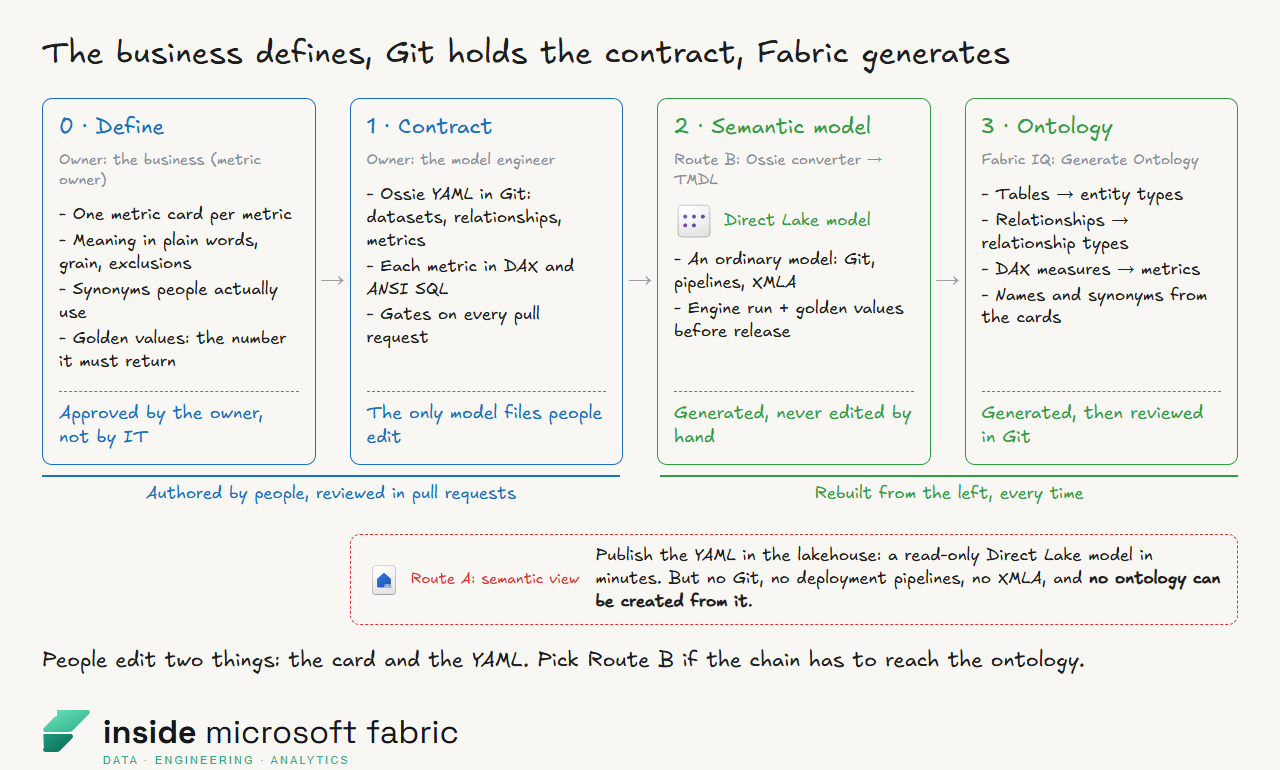
Four stages, one owner each:
- Define. The business writes what the metric means.
- Contract. An engineer turns that into Ossie YAML in Git.
- Semantic model. Generated from the YAML.
- Ontology. Generated from the semantic model.
The rule: people author stages 0 and 1. Stages 2 and 3 are output. Nobody opens the generated model to “just fix one measure”, because the next build overwrites it, and then the YAML and the model disagree in production.
This is the same position as the Fabric Apps article: when Fabric doesn’t keep the history, the repo does. Here it goes one step further. The repo also keeps who decided what a number means.
Stage 0: give the business the pen
Most semantic layer projects start in YAML. That’s already too late.
When the data team writes the definition of net revenue, what you get is the data team’s opinion of net revenue. It’s versioned, tested and wrong in a way nobody notices until the board pack and the sales agent disagree. The hard question was never the tool. It’s who owns this.
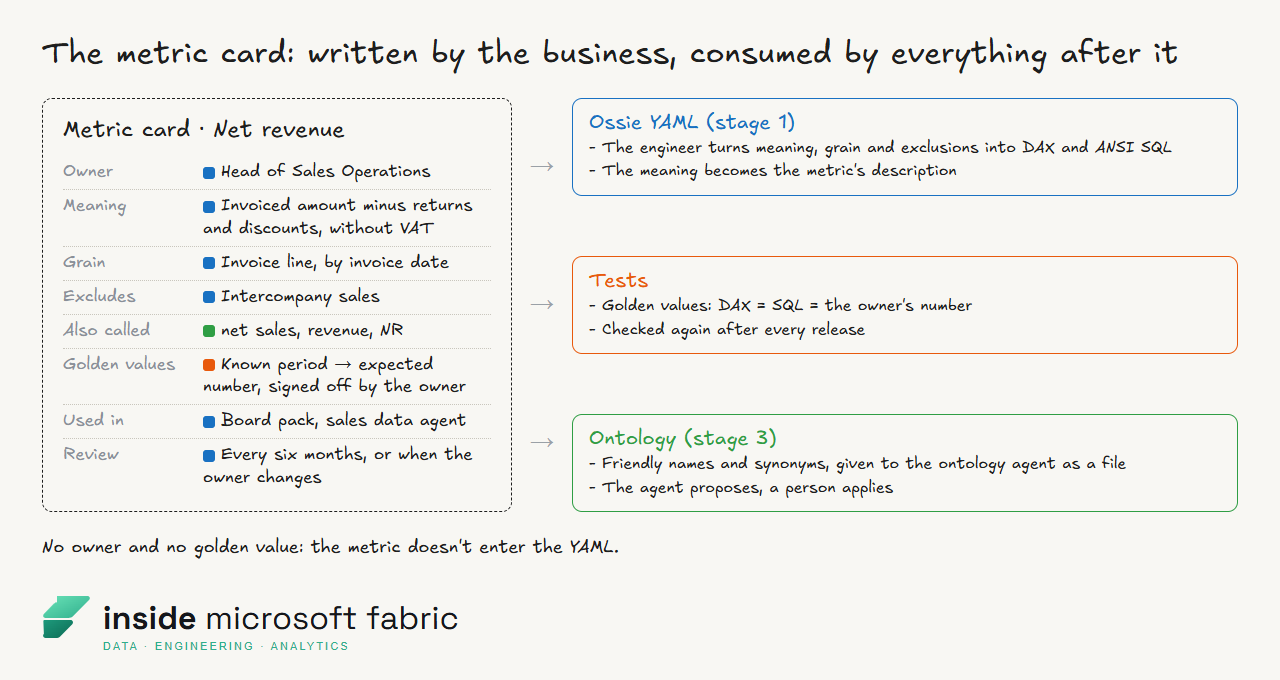
So before any YAML, each metric gets a metric card, written in business language by the person who answers for the number.
What goes on the card
| Field | Why it’s there |
|---|---|
| Owner | A role and a name. The person who approves changes to the meaning |
| Meaning | One or two sentences a new colleague would understand |
| Grain and exclusions | Where most disagreements actually hide |
| Also called | The words people type into Copilot. They feed the ontology later |
| Golden values | A known period and the number it must return, signed off by the owner |
| Used in | Who breaks if this changes |
| Review | A date. Definitions rot quietly |
The golden values are the field that turns governance into something you can test. A definition the owner has signed with a number can be checked on every release. A definition without one can only be argued about.
Roles, not committees
| Role | Decides | Doesn’t decide |
|---|---|---|
| Metric owner (business) | What the number means, the golden values | How it’s computed |
| Domain steward | Naming, overlaps between domains, the review date | The formula |
| Model engineer | The DAX and SQL, the relationships, the YAML | The meaning |
| Platform team | The gates, the build, the release | Either of the above |
The engineer can push back (“that grain can’t be computed from this table”), but the change goes back to the card and the owner approves it. The meaning never changes silently inside a DAX expression.
Where the card lives
Wherever the business already writes. A form, a list, a small Fabric App, a Markdown file edited in the browser. The only hard requirement is the output: every card change lands in Git as a reviewable change, next to the YAML it governs, so a pull request shows the meaning and the formula changing together.
One thing I wouldn’t do today: start a new glossary process in Microsoft Purview Unified Catalog. Microsoft is retiring Purview data governance and consolidating it into Fabric. No new accounts, maintenance mode until 12 November 2027. Keep the definitions in the repo until the Fabric side is clear. Files move. Tools get retired.
Stage 1: the YAML is the contract
Once a card is approved, the engineer writes it into Ossie YAML: datasets, relationships, metrics. These are the only model files anyone edits. A few rules make the rest of the chain safe:
- Write every metric twice, in DAX and in ANSI SQL. Fabric publishes only DAX, and every other consumer reads SQL. The Ossie converter deliberately translates only a small subset of SQL and leaves a warned placeholder for the rest, because a partial translation returns the wrong number. Author the DAX yourself.
- Pin the spec version in one place. The repo stays on the version you validate against; the build produces the Fabric-bound copy on
0.2.0.dev0. That adapter is the seam that will break when Fabric moves, so it’s the first thing to test. - Stay inside the Fabric subset. Single-column relationships, every relationship active, schema-qualified tables as sources. Unsupported constructs are dropped with a warning, not an error, so a green publish doesn’t mean nothing was lost.
The gates, as a strategy
I won’t put pipeline code here; your CI tool doesn’t matter. What matters is which check runs where, and what it blocks.
| Gate | What it proves | When | Blocks |
|---|---|---|---|
| Card | Owner and golden values exist, card and YAML changed together | Every pull request | Merge |
| Shape | YAML parses, version pinned, file limits, .yaml extension |
Before commit | Commit |
| Spec | Ossie schema, unique names, keys and joins point at real fields | Every pull request | Merge |
| Fabric fit | Every metric has DAX, only supported constructs, converter in strict mode with no placeholders | Every pull request | Merge |
| Parity | DAX and SQL return the same number, and it matches the golden value, on a small fixture | Every pull request | Merge |
| Engine | Deploy to a scratch workspace, evaluate every measure, delete | Release branch | Release |
| Smoke | Golden values against the published model | After release | Rollback |
The engine gate exists because of the nastiest failure the Ossie converter documents: a measure whose DAX doesn’t compile is dropped from the deployed model. Querying it returns no rows, not an error. Offline checks can’t see that. A loud failure is fine. A silently missing number is the real risk.
Stage 2: two routes to the semantic model
Both routes read the same YAML, so the choice isn’t permanent. But it decides where the chain can go next.
| Route A: semantic view | Route B: Ossie converter to TMDL | |
|---|---|---|
| How | Copy the YAML to the lakehouse, click Publish | Convert to TMDL in the build, deploy it as a normal Direct Lake model |
| Result | Read-only model, rebuilt on every publish | An ordinary semantic model |
| Git, deployment pipelines | Not supported | Supported, like any semantic model |
| XMLA | Blocked, even read-only | Available |
| Generate an ontology from it | Not supported | Supported |
| Best for | A fast, governed start for reports and agents | Teams that need promotion and the ontology |
Route A is a good way to start. It’s the quickest way to show the business their definition working in a report, and the generated model inherits its permissions from the lakehouse, so access is simple.
But if the end of the chain is an ontology, Route A is a dead end today. If the ontology is the goal, Route B is the main route. Keep Route A for the fast start, and remember the generated model is disposable: deleting the lakehouse deletes it.
On Route B, the discipline matters more, because nothing stops someone from editing the model. The rule from the chain holds: the deployed model is output, and every change goes through the card and the YAML.
Stage 3: the ontology, generated
An ontology answers a different question from the semantic model. The model says what’s measurable. The ontology says what the business things are and how they relate, so agents can reason in business terms instead of table names.
Fabric IQ can generate an ontology from a semantic model with one button. From the Route B model you get:
- Entity types from the tables
- Properties and data bindings from the columns
- Relationship types from the model’s relationships
- Metrics from the DAX measures, the same measures the owner signed off
That last point closes the loop: the number the business defined on the card is the metric the ontology exposes to agents.
What the button doesn’t do
Microsoft lists the manual steps after generation: bind time series data, review entity keys, bind relationship types to data, rename entities to friendly names, and review the whole thing.
This is where stage 0 pays off a second time. The friendly names and synonyms are already on the metric cards. The ontology agent accepts files as context (data dictionaries, requirements, up to 10 files of 5 MB each), works in Plan mode by default and previews every change before applying it. Give it the cards, let it propose, and have a person apply.
Then treat the ontology like the model: the ontology item supports Git integration (preview), so its definition lands in the repo and every change is a diff someone reviews.
The requirements that will bite
- Direct Lake, not Import. Ontology data bindings aren’t supported for Import mode models, or for Direct Lake when the lakehouse’s workspace has inbound public access disabled. Route B on Direct Lake fits.
- Read and Build permissions on the model, and not in My workspace.
- No
Decimalin the graph. Decimal columns come back as null in queries. Money is usually Decimal. Check this before the demo, not during it. - Property names must agree on type across entities. A string
IDin one table and an integerIDin another breaks generation. - Data agents. A current known issue: a data agent doesn’t work with an ontology that uses semantic models for binding. Check the troubleshooting page before you promise an agent on top.
And Ossie’s own ontology layer?
Ossie 0.3.0.dev0 has its own ontology layer: concepts, relationships with a required business sentence, and a mapping document that ties them to the semantic model. It’s the right long-term shape, because the ontology would then live in the same YAML, reviewed by the same people.
But I found no converter from Ossie to Fabric IQ ontologies, and the spec says tools don’t yet parse standalone mapping documents. Until that exists, the strategy is: generate the Fabric ontology from the model, enrich it from the cards, version it in Git. When the converter arrives, it replaces the generation step, and the cards stay where they are.
What can break
| Risk | Why | Guardrail |
|---|---|---|
| Definitions written by IT | The YAML becomes the data team’s opinion | Stage 0: no card, no metric |
| Spec drift | Fabric on 0.2.0.dev0, Ossie moving to 0.3.0.dev0 |
One version adapter, tested in the build |
| Silent missing numbers | Placeholders, measures dropped at compile | Strict conversion, engine gate, golden values |
| Two dialects drift | DAX and SQL written by hand | Parity against the golden values |
| Hand edits on generated output | “Just one quick fix” in the model or ontology | Generated means rebuilt; changes go through the card and YAML |
| Dead end to the ontology | Route A’s model can’t generate one | Route B for anything that must reach Fabric IQ |
| Preview churn | Limits and APIs are still moving | Re-read the Learn limits before each release |
What to do on Monday
- Pick five metrics that already cause arguments. Write a card for each with its owner, in their words.
- Get golden values signed for those five. If an owner can’t give a number, you’ve found your first governance problem.
- Create one repo: cards and Ossie YAML side by side, the only files people edit.
- Publish one semantic view (Route A) to show the owners their definitions working. Keep it as a demo.
- Build the Route B model from the same YAML with the gates in place, on Direct Lake.
- Generate the ontology from the Route B model, give the cards to the ontology agent, review its proposal, and connect the ontology to Git.
- Run the golden values after every release. When one fails, the owner hears about it before the board does.
What I haven’t verified
- Whether a semantic view can be published by a service principal. Learn only rules out third-party tokens.
- Whether regenerating an ontology keeps manual enrichment. Generation creates a new item, so I’d assume it doesn’t and keep the enrichment reproducible from the cards.
- Exactly what differs between
0.2.0.dev0and0.3.0.dev0for a Fabric-bound file, so the adapter’s real size is unknown.
The YAML is the contract, but the contract is only as good as the person who signed it. Put the business owner at the start of the chain and generate everything after them.
Are you already running a semantic layer in Git? Who writes the definitions in your team, the business or the data team? I’d love to hear how you’ve split it.
Enjoyed this?
Get new articles like this one straight to your inbox.